Tag Archives: Hope

Reflections at Sixty

I recently turned sixty.  A lot of water has passed beneath the bridge of my life with what feels like dizzying speed.  How could I have lived six decades already?  Where in the world has all the time gone?

As I reflect, I am struck first and foremost by a deep sense of gratitude.  God has blessed me with so many precious people who have deeply impacted me: parents, family, friends, wife, children, and grandchildren.  I have been given so much more than I deserved through the years: food, clothing, shelter, and health.  There have been incredible and undeserved opportunities to serve God and help others to come to know and grow in their walks with Him all over the world.

Of course, there are many regrets.  I openly acknowledge my many shortcomings, failures, character flaws, and sins.  I wish I were more patient, more humble, more kind, more emotionally engaged and mature.  I wish I were a better listener, asked more and better questions, had a greater sense of teachability and curiosity.

I somehow thought I would be significantly further along in my personal and spiritual maturity by now.  And while I have known many precious moments with Him, I believed that walking closely with Jesus would be easier and sweeter by now than it actually is.  My Christian life is still a daily struggle of wrestling with sin, character flaws, and bad habits.

Beyond this, there have been many deep heartaches and profound disappointments.  Some family and friends have disheartened me by walking away from the faith.  I’ve also caught myself asking: What has my life meant and accomplished?  I had big dreams in my youth.  Have I really followed Jesus whole-heartedly?  Has my life truly mattered and made a difference, making a lasting impact that genuinely honors God?

Nevertheless, in the face of all this, God’s goodness and faithfulness has been undeniable and unwavering.  I see without question the kindness, grace, and patience of a compassionate God who continues to love, forgive, and provide for me a life I never dreamed possible and the privilege to be used by Him in ways I never deserved or could have imagined.

This life has been, is, and always will be, a gift.  And now that I am fast-approaching the increasingly evident tail-end of it, Joe Rigney’s words hold a special significance: “Those at the beginning and the end tell those of us in the middle: This was you: weak, frail, dependent, and needy.  This is you: weak, frail, dependent, and needy.  This will be you: weak, frail, dependent, and needy.  You are a vapor, here today and gone tomorrow.  And your life is not your own.  It is a gift.”

Thank You, Lord, for creating, loving, and saving me.  Thank You for continuing to transform and conform me to the image of Your beloved Son.  Thank You for graciously giving me sixty years of life.  And thank You for the astonishing hope of eternal life in Christ that enables me to look to the future with unspeakable joy versus devastating dread or deluded denial.  You truly are a gracious, kind, and loving God!
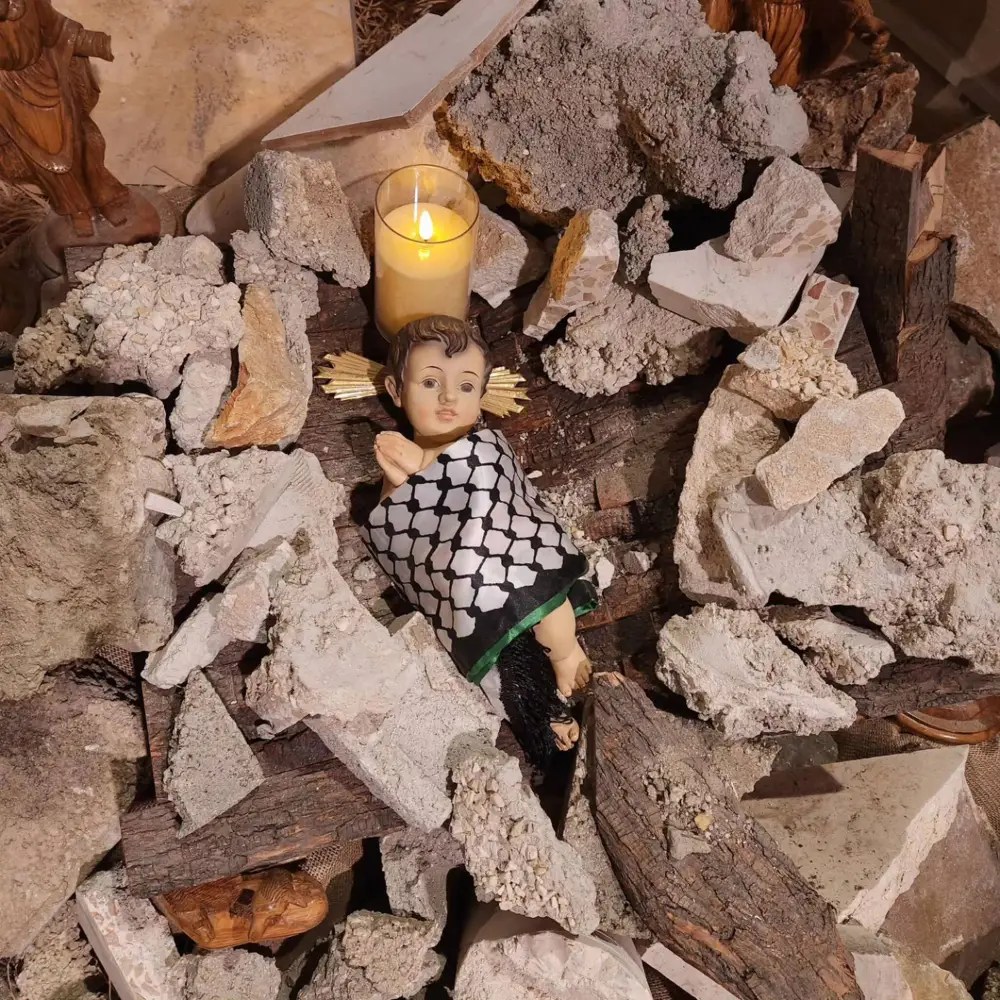
Jesus Amidst the Rubble

It’s all over the internet, a picture of baby Jesus lying amidst the rubble of a bombed-out building.  The idea is that if Jesus was born in Gaza today, He would not be safely lying in a manger on silent and holy night, but in a war zone with His life in desperate danger.

Doubtless, such an image helps shake us from the contemporary temptation to forget the radical nature of Christ’s coming to earth, not as a conquering messianic King like the Jews expected, but as the vulnerable suffering servant, born a defenseless baby in a tiny backwater town to a displaced peasant couple.

And when the angels appeared to announce His coming, they did not come to the rich, powerful, and well-connected.  They didn’t even come to His parents.  Instead, they appeared in the middle of nowhere to the lowliest of the low, a dirty, despised, and devalued class of people—shepherds—to make their declaration. And what was the message of this terrifying event?  A Savior is born “who is Christ and Lord.”  In short, He was the long-awaited Messiah (Christ in Greek), and He was Lord, the King above all Kings.

We know this in part because of Isaiah’s prophetic promise in chapter seven telling us that “the virgin shall conceive and bear a son, and shall call his name Immanuel,” and later in chapter nine that “the government shall be upon his shoulder, and his name shall be called Wonderful Counselor, Mighty God, Everlasting Father, Prince of Peace.  Of the increase of his government and of peace there will be no end.”

In this light, we would be deceived to think that Jesus’ birth was somehow safe, sensible, and apolitical.  Herod understood all too well the nature of Christ’s coming, and his paranoid political madness cost the lives of countless boys below the age of two because Jesus was a clear and present danger to his godless earthly reign.

Herod’s attempt to eliminate Jesus as a political threat, however, betrays the perennial tendency in our own time to make Jesus primarily an earthly political figure in a world of God-defying injustice, as if Jesus came to save the world by becoming another (presumably better) earthly king.  To be sure, He came as King, but a King who first and foremost came to serve, suffer, and sacrifice Himself to save us from the disordered debris of a world damaged and shattered by sin.

But it takes deep humility to recognize and admit our dire and dreadful state of disorder.  Instead, we desperately try to rebuild and renovate the wreckage of our lives, devising many creative and clever ways to deny or sweep it aside, reform it into more acceptable shapes and sizes, or even to somehow make peace with it.

The profound irony is that this seemingly helpless baby Jesus amidst the rubble is our only hope for restoration and peace.  He lovingly dwells in the midst of our battered and broken lives, miraculously molding us into something strong, significant, and beautiful.  But He only does this when we finally relinquish our futile attempts to redeem ourselves and fully trust in Him alone to forgive, restore, rebuild, and transform us from the inside out.

What’s on your bucket list—and why?

The idea of a “bucket list” was popularized by the 2007 film, “The Bucket List.”  It’s a list of things to do and places to go before you die, i.e., “kick the bucket.”  For example, I would love to visit Alaska, a state extolled for its transcendent natural beauty, but one I have only seen in pictures.

I should, however, clarify that I have very little to complain about concerning the life experiences enjoyed and amazing places seen.  By God’s graceI’ve experienced the magnificent majesty of the Grand Canyon and Yosemite National Park, enjoyed the beaches of Southern California, Bali, and Phuket, trod the Great Wall of China, eaten armadillo in the jungles of Bolivia, visited the Bavarian and Austrian Alps, wandered the north woods of the upper Midwest, paddled in the crystal clear fault lakes of the Canadian boundary waters, seen the corals of the Great Barrier Reef, swam in the bracing cold of the Great Lakes, seen the Holy Land, the Coliseum in Rome, the Tower of London, the ancient ruins of the Seven Churches in the book of Revelation . . . .  The list could go on, and yet, I’ve still never been to many breathtakingly beautiful places in Europe, Africa, Russia, New Zealand, or even outer space.  Given my age and income level, it’s likely I won’t see most (if not all) of them before I die.

Even if I had the time and money, however, the sheer size and majesty of this world (not to mention the universe), would make it extremely hard to “see and do it all” in a single lifetime.  Seeing the obsessive passion with which some people create and pursue the fulfillment of their bucket lists, I can’t help but wonder if certain assumptions lie beneath the fervor to see and experience as much of the world as possible before death.

Probably the primary motivation is that since “you only live once” (which is true), you can only enjoy what this world has to offer before you die (which is false).  The materialist assumption that lies behind the drive to do everything possible before death suggests that once you die, you simply no longer exist.  We should therefore “eat and drink, for tomorrow we die” (1 Corinthians 15:32).  But if we are made for eternity (Ecclesiastes 3:11) and have trusted in Christ, we can confidently anticipate a gloriously indescribable future beyond this fleeting life that will be spent forever in a new heaven and a new earth (Revelation 21-22).  Even the most breath-taking experiences we can muster in this passing life are mere faint and shifting shadows compared to the unimaginable magnificence of the life that is to come.

Please don’t misunderstand me.  There’s nothing wrong with wanting to see the many splendors of this world that God has made.  He has, after all, created it to reflect His own majestic beauty and bountiful wisdom.  The heavens really do declare His glory (Psalm 19:1).  Creation is a dim but very real reflection of the glory of our God and Maker, making it a many-splendored thing, worthy to be explored and experienced with awe and gratitude.

The drive to both make and complete a bucket list, however, can cause us to forget that as wonderful and beautiful as the things of creation are, they ultimately pale in comparison to what we will know and experience in eternity.  Even if you never fulfill your wanderlust, even if you never have all the thrills and experiences that our existential age promotes as essential for fulfillment (you assuredly will not), it is a profound and concrete comfort to know that these longings are merely meant to remind us that we are ultimately made for another (and magnificently better) world.

As C. S. Lewis so beautifully put it in Mere Christianity, “If I find in myself a desire which no experience in this world can satisfy, the most probable explanation is that I was made for another world.  If none of my earthly pleasures satisfy it, that does not prove that the universe is a fraud.  Probably, earthly pleasures were never meant to satisfy it, but only to arouse it, to suggest the real thing.”

Here is how John describes this magnificent world in Revelation 21: “Then I saw a new heaven and a new earth, for the first heaven and the first earth had passed away, . . .  And I heard a loud voice from the throne saying, ‘Behold, the dwelling place of God is with man.  He will dwell with them, and they will be his people, and God himself will be with them as their God.  He will wipe away every tear from their eyes, and death shall be no more, neither shall there be mourning, nor crying, nor pain anymore, for the former things have passed away.’”

I’m putting this destination, accessible through faith in Christ alone, in the pole position of my bucket list.  And thanks to Jesus, when I finally do kick the bucket, it’s a place I will never have to worry about missing out on.  After all, He will be there in all His unmasked glory, and I will finally see Him face to face.

Finding Hope and Joy at Christmas

I have many fond memories of past childhood Christmases as well as those spent with our own children (now grown and on their own).  Children possess both a joyous anticipation and an enduring sense of wonder over the Christmas season.

Of course, not all this wonder and anticipation grows from the soil of pure motives.  Getting as many gifts as possible always lurks just below the surface.  And yet, many much more important things helped point our hearts in the right direction, bringing a genuine sense of joy and true anticipation: the spiritual rhythms of advent season at church, the Christmas eve candlelight service, the singing of carols, rituals of tree acquisition and decoration, special indoor and outdoor ornamentations, extended times of fun and fellowship with family and friends, cookie baking and eating, special meals, foods, and movies, the reading of the Christmas story, and so much more.  These holiday traditions afforded a deep sense of Christian grounding and identity in a world filled with bitterness and fear.

Too often in my adult years, however, the only sense of anticipatory joy is born of the hope that Christmas will soon be over so a “normal” pace of life can be restored.  Somehow in the rush to make Christmas memorable, I often forget to make it meaningful in all the right ways.  That sense of wonder and hope, so prevalent in childhood, is often nearly lost.

Not only this, the challenges of life in a fallen world keep forcing me to come face-to-face with the realities of living a world marred by sin.  More importantly, they continually reveal the many ugly and dark aspects of my own soul.  I find it harder and harder to escape the obvious sins, scars, and dysfunctions that seemed much easier to brush aside in youth.  But while the demands of the Christmas season can easily make us jaded and cynical in ways that push away any deep sense of joy, wonder, or hope, it is still possible to experience these things once again.

When Simeon took eight-day-old Jesus in his aged arms, he offered thanks to God this way: “My eyes have seen Your salvation that You have prepared in the presence of all peoples, a light for revelation to the Gentiles, and for glory to Your people Israel.”  Simeon’s faith-filled and joyous hope helped him see that God’s coming salvation for the whole world was somehow bound up in this holy Infant.  Reading the rest of the astonishing story, we see this truth ever more clearly, that Jesus is Immanuel, God with us.

Hope and joy may be in short supply these days, but when we take Jesus in our arms and gaze amazed upon Him once again, we can recapture that sense of joyous hope that our gracious God will wondrously save and restore all who hope and trust in Him.

The Happiest Place on Earth

In a recent study (and contrary to the hopes and claims of the Disney corporation), Finland was recognized as the “happiest place on earth.” It is, incidentally, also one of the least religious places on the planet. While nominal Christianity is widespread at around 70%, only 8% of the population attends church services on a monthly (or more) basis and only 3% attend weekly.

When I began walking more closely with Christ in college, I was told that people without Jesus were, deep down inside, unhappy. It didn’t matter how easy their life was, how much money and things they possessed, or how happy they appeared on the outside. If they didn’t know Jesus, they had to be miserable. Perhaps they were dishonest about their misery, rushing to allay and cover over the existential sadness with money, sex, fame, power, experiences, and relationships. Or perhaps they were somewhat unaware of and blind to their inner turmoil, needing to be shown the bankruptcy of their life apart from a right relationship with God. Regardless, they simply couldn’t be happy without Jesus.

I believed this assessment largely because it was true in my own experience: When I wasn’t walking with God, I was deeply dissatisfied with life. The longer I’ve lived, however, the more I’ve come to realize that while there are many unhappy non-Christians in the world, there are also a fair number who appear to be genuinely happy and self-satisfied.

Does any of this fundamentally challenge the significance, truth, and power of the Christian gospel? In fact, in some ways, it reinforces it, because it demonstrates sin’s blinding power and how the world can deeply deceive those who love it and want nothing more than what it has to offer. As Lennox and Gooding point out in The Definition of Christianity, people who have worldly power, wealth, and respect have a strong vested interest in maintaining their place in this world. In short, “The world, as it [is, is] good enough for them. They [cannot] see all that much wrong with it.” This also shows how much human beings can put their hope in vain and worthless things, oblivious to or in direct denial of the dangers that await when their lives are ultimately called to account by a holy, just, and all-knowing God.

For struggling Christians, it can be easy to forget the fate of unbelievers, particularly when their lives seem filled with joy and ease, when they appear to be in control, and especially when they arrogantly and openly deny and disdain the God who made them. But as Asaph points out in Psalm 73, there is more to the story than first meets the eye. After seeking the Lord and regaining his perspective, he concludes, starting in verse twenty-five, this way: “Whom have I in heaven but you? And there is nothing on earth that I desire besides you. My flesh and my heart may fail, but God is the strength of my heart and my portion forever. For behold, those who are far from you shall perish; you put an end to everyone who is unfaithful to you. But for me it is good to be near God; I have made the Lord God my refuge, that I may tell of all your works.”

To be sure, there are many unhappy pagans in the world searching high and low for something or someone greater, better, and more meaningful. May they find the one and only God who can bring true joy and satisfaction in their quest! But for those like the Finns who seem genuinely satisfied with their life apart from God, the real reckoning may not come in this life.

One day God will judge the living and the dead and inaugurate a new heaven and a new earth. All who trust in Him will know and experience the everlasting hope of being intimately loved by the One who gave Himself as a living sacrifice. Only then we will live in the fullness of joy. And only then will we realize that all other so-called felicities pale in comparison. On that day, and forevermore, we really will be living in the happiest place in heaven and on earth.

In whom or what are you hoping?

85

With the recent coronavirus outbreak, people have turned in a myriad of directions to find hope.  Some have turned to the government and medical professionals to protect them, others have turned to miracle cures available for purchase on the internet, still others have turned to superstitions and rituals to provide the defenses that they need to combat this unseen menace.

All of this illustrates that people hope in lots of different things: economic prosperity, global initiatives for solving climate change, better political leaders, educational reform, religion, meaningful friendships and romantic relationships, good food and drink, the newest diet plan, the latest entertainment options and social media platforms, better healthcare—the list is nearly endless.

Not so long ago in America, most people put their hope in a higher power, something or someone beyond themselves.  But as the world became increasingly secular and disenchanted, all people could hope in were material (economic, psychological, scientific, political) solutions for what were ultimately spiritual problems manifesting themselves in material ways.

In fact, the Bible talks a lot about hope.  But the direction of our hope is not especially material in nature—or at least it shouldn’t be.  Our hope for this life is directed to that which—or better, the One who—is beyond it.

The deep irony, of course, is that when you find your hope in something (really, Someone) beyond this world, you are more likely to live your life more fully in this world.  And when you only put your hope in the people and things of this world, you are more likely to find your hopes for this life repeatedly disappointed and unfulfilled.

Many of my non-Christian friends are putting their hope in better medicine, a new election, a new educational initiative, a new car, a new spouse, a new. . . .  And I understand that.  When you have merely material priorities, the only things you can reasonably hope in are material solutions.  What grieves me is when Christians fall into the trap of hoping in and caring more about material solutions than spiritual ones.  Yes, they are interconnected, but the amount of passion we give to our highest hopes and the direction in which they move us matter immensely.

This is especially true when a crisis like the recent virus outbreak occurs.  The world is watching to see if we truly believe, trust, and hope in God above and beyond all other possible hopes.  As Psalm 33:20-22 says, “Our soul waits for the Lord; he is our help and our shield.  For our heart is glad in him, because we trust in his holy name.  Let your steadfast love, O Lord, be upon us, even as we hope in you.”  Indeed, whether we live or die, He is our one and only true hope.

In whom or what are you hoping?

When Death Finally Finds Me

neglected-tombstone-871282318363ZJWj

No one lives forever.  In less than a week I will be closer to 60 than 50 and am astonished at how quickly the moments of my life keep racing by.  Everyone admits we will all die someday, but “someday” always seems to be an ambiguous and nonspecific point in the distant future.  We convince ourselves that “someday” will never be this day.

But soon enough for all of us, “someday” will become “today” and we will cross that great divide and pass on into death.  And some of us, whether or not we admit it, are closer to that day than others.  Contrary to many inspirational speakers of our day, thinking about death is not an exercise in morbidity or negativity.  From a biblical perspective, it is an exercise in circumspection and wisdom.  Moses puts it this way in Psalm 90: “The years of our life are . . . soon gone, and we fly away. . . .  So teach us to number our days that we may get a heart of wisdom.”

Thoughts about death fundamentally change our attitude in life and the manner in which we spend the precious time God so graciously grants each of us.  The only question we must ask ourselves today—and every day God gives us life—is this: Am I letting God use me for His glory?  Am I being truly and fully faithful to Him right now?

Lord God, help me remember the brevity and transience of this life.  Give me the grace to trust in and follow You all the days of my life, starting with today, so that when “someday” finally comes, I can meet You in the glorious life that is to come free of all shame and regret.

The Longing to Be Whole

longing

The Best Years of My Life?

I was often told by well-meaning adults that the years of my youth would be the best of my life.  But in many ways, these years were anything but wonderful.  Although things at home were Christ-centered, stable, and supportive, life at school was positively miserable.  I remember vowing to remember what it was really like when I was young.  Life was full of formidable hardships and hurts.

Now that I’m older, it is much clearer that every life-stage is filled with tests, trials, and tribulations. They are inherent to the fabric of life within a fallen world.  For many, however, it is all too easy to see the past through rose-colored glasses, only recalling the joys and few, if any, of the sorrows.  In retrospect, the years of youth particularly seem like a time filled with wonder, strength, and beauty.  We long to be young again.

The Price of Wisdom

Part of this longing, I think, is produced by the physical reality of aging.  Herein lies a study in contrast.  On the one hand, with age comes wisdom.  And for this reason, I would not want to return to the foolish naiveté of youth for anything.  But wisdom comes with an unavoidable price—the price of both physical and emotional injury.  And while the emotional toll is immensely important, it is to the physical my thoughts have turned lately.

With time comes decay. Eventually, our bodies wear out and stop working well.  Ever since the fall, physical pain and death are an inevitable part of life.  In some way, shape, or form, we all experience the debilitating effects of sin and our bodies start “giving up the ghost.”  For some, that relinquishing comes sooner and exacts a greater cost.

Properly understood, this can help us contemplate the fleeting and fragile nature of material existence.  My early-onset deafness and chronic back and neck pain (for example) have forced me to face my mortality.

The Longing to Be Whole

In the midst of it all, we often find ourselves longing for the bodies of our youth when we heard and saw with unaided clarity, when we woke up without a morning backache and aching joints, when we had rock-hard stomachs and baby-soft skin.  In short, we long to be strong and young and whole again.

The world also has this God-given longing, but without any real prospects for a permanent reformation. The best they can hope for are more painkillers, a shot of cortisone, a botox injection, a tummy tuck, and a facelift.

The Source of Real Hope

In blessed contrast, believers are given “a living hope through the resurrection of Jesus Christ . . ., an inheritance that is imperishable, undefiled, and unfading, reserved [for us] in heaven” (1 Peter 1:3-4).  There, we will see without glasses, hear without microcircuits and air-zinc batteries, and live without pain.  There will be no more death, agony, or aging.  Thank God, we will finally and unceasingly be whole.

What happened to you? Facebook After Thirty

2000px-Facebook_New_Logo_(2015).svg

Since joining Facebook, I discovered something unanticipated.  When I left high school and college, I unconsciously retained mental snapshots of my old friends and classmates.  In short, I thought I knew what they looked like.

Friending “old” friends on Facebook demonstrated—sometimes very starkly—something I knew in theory but never fully grasped in reality: somewhere over the past thirty-plus years, we all became genuinely old.  Looking at the profile pictures, I sometimes found myself silently asking, “What happened to you?”  Even more telling was the next logical query: “What happened to me?”

Sure, some of the guys still had most of their hair and others managed to keep most of the weight off, but thirty-plus years had taken a tremendous toll on us all.  It’s a helpful reminder, really, of something too easily forgotten or ignored.  When you are young and strong and beautiful, every new day seems a lot like the day before. You may have made some stupid and immoral decisions yesterday, but youth often enables you to bounce back rather quickly and with minimal effort.  However, after more than three decades, all that bouncing has left behind an increasingly weighty list of aches, pains, scars, wrinkles, and regrets.

While contemplating this, I came across Isaiah 56:12 which says, “Come, . . . let me get wine; let us fill ourselves with strong drink; and tomorrow will be like this day, great beyond measure.”  The attitude is essentially this: we can fill each day with drunkenness and strong drink because tomorrow will be just like today—another day to party and have a good time.  It will always be like this.  Life will never catch up to us.

Thirty years and the Facebook time-warp has rather unceremoniously ripped off the illusory mask. Tomorrow keeps on coming.  Sooner or later, tomorrow is no longer just “like this day.”  Today’s tomorrows become weeks, months, years, and decades.  The daily choices we make—good, bad, and neutral—exact a small but growing (and ultimately measurable) price.  It’s more obvious than ever: none of us will live forever.  Each today is decidedly not the same as yesterday.

In light of our increasingly evident mortality, I thank God that each tomorrow will not be “like this day.”  No matter how wonderful or awful any given day is, some undisclosed future “today” will bring it all to a blessed end.  Death will finally find me.  And on that glorious day, I will finally see my Savior, Jesus, face-to-face.  That’s when, for all eternity, every tomorrow will not be like this day, but ever and always an even better day than the one before.  I can hardly wait!

Thirty Years in Ministry: A Reflection

96889_0

When I joined Cru in July of 1987, I intended to be a “lifer” with the organization.  Looking back, I had no clue what that might actually look like over the long haul.  In many ways, it was little more than a romantic dream, a well-intentioned but poorly-understood commitment to follow Jesus to the ends of the earth and back, no matter what the cost.

More than thirty years later, reality looks a lot different than the dream.  I wanted to do great things for God, be known for exceptional devotion to and love for Him, give my all for the sake of the gospel.  In retrospect, my heart for and obedience to the Lord has often wavered, sometimes reaching embarrassingly low levels of commitment.

Back then, I thought that being in ministry for thirty years would have forged in me a more Christ-like character and provided me with some wonderful words of wisdom to share with those coming behind.  Truth be told, I do not feel especially righteous, sagacious, or qualified to offer others a stellar example or share anything truly compelling or profound.  The milestone came and went without much fanfare or notice.  Before and after, the mundane tasks of everyday life in ministry remain strangely familiar.  Nothing stands out as fundamentally different than before.

What is most noticeable is not my extraordinary commitment or growing resemblance (or lack thereof) to Jesus over the past thirty years.  Rather, it is the immense and inexorable faithfulness of God.  As 2 Timothy 2:13 says, “If we are faithless, He remains faithful, for He cannot deny Himself.”  Above all else, God has been faithful, and His faithfulness continues to evoke gratitude and hope.

Gratitude comes from reflecting on the ongoing opportunities and graces, all undeserved, which God has granted and continues to give.  I’ve had the privilege of serving Him all over the world, of journeying through life with a beautiful, godly, loving, and loyal wife, of enjoying the joys and trials of parenting three wonderful children, of seeing God continually supply our every need, of being used to bring about eternal life change in numerous Christian leaders, and of experiencing the profound presence of God in ways I never dreamed possible.

Hope comes from knowing that no matter how far and repeatedly I fall short of His ideal, no matter much earthly time God grants me, He remains ever faithful, patient, and kind.  I am secure in His love and in the riches poured out upon me through the goodness of Christ, and will enjoy these unmerited benefits for all eternity.

I am reminded of some words from a beautiful hymn written by Keith and Kristyn Getty, “My Worth Is Not in What I Own.”

As summer flowers, we fade and die

Fame, youth and beauty hurry by

But life eternal calls to us at the cross

I will not boast in wealth or might

Or human wisdom’s fleeting light

But I will boast in knowing Christ at the cross

Two wonders here that I confess

My worth and my unworthiness

My value fixed, my ransom paid at the cross

I rejoice in my Redeemer

Greatest treasure

Wellspring of my soul

I will trust in Him, no other

My soul is satisfied in Him alone

Thank You, Lord, for the immense privilege of serving with You for more than thirty years, and for continually demonstrating Your faithful lovingkindness.