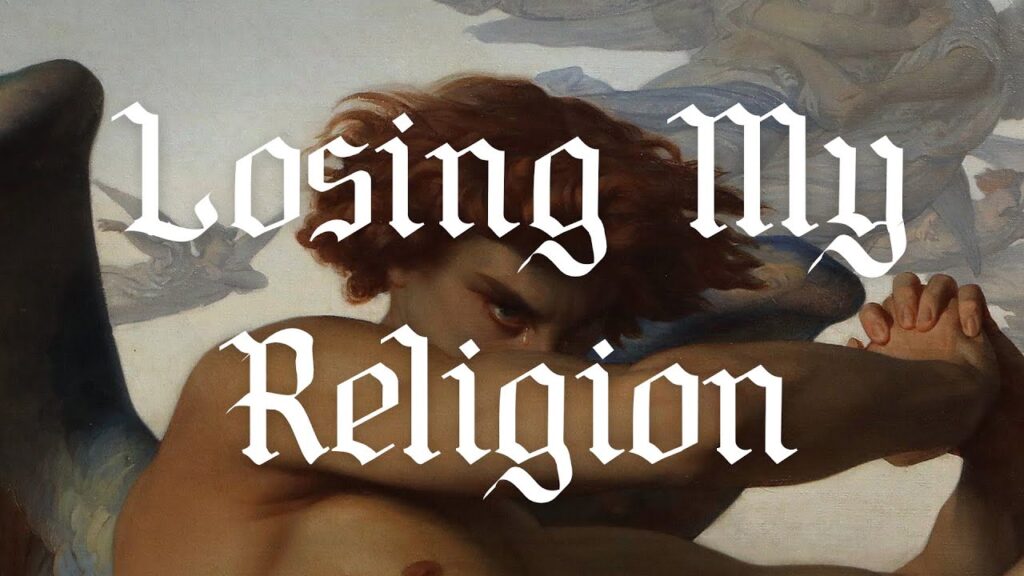
“That’s me in the corner, that’s me in the spotlight, losing my religion.” (R.E.M.)
I heard it again today. Another high-profile Christian announced he is no longer a believer and has left the faith. I could mention his name, but he is not the first and sadly will not be the last.
For those of us who still consider ourselves Christians, events like this always raise hard questions. What leads people into, and in this case, out of, the Christian faith? Can a person actually lose their salvation? Can and will they ever return to the fold? How should we react to the news and toward the person involved?
There are other questions that could also be asked, but I only want to focus on the second part of the first question: Why do some people leave the faith? It’s a question I’ve been asking a lot recently, and the answers have been interesting. One person told me he left Christianity because of disappointment with God. But in coming back to the faith after thirteen years of active rebellion, he saw in retrospect, his disappointment was really just another form of idolatry. He wanted God to meet Him on his own terms. My friend didn’t want God to be God. He wanted God to be who (or what) he wanted Him to be.
Another factor is something I call, “celebrity culture.” In an age when every aspect of your life can be broadcast across the entire planet in an instant, and be massively responded to by complete strangers, the pressures to conform, perform, and not offend, can be truly overwhelming. If I don’t want to offend others and try to defend unpopular beliefs, the easiest thing to do is leave them behind. Pressures like these were certainly there in Paul’s time as well. Galatians 1:10 makes it clear that the temptation to be a people-pleaser rather than a God-pleaser was and remains a powerful and dangerous force.
I thank the Lord often that He did not make me famous and overly gifted. Celebrity culture and the possession of exceptional talents can be terrible things to manage when you’ve had few chances to mature and trust in God without the eyes of the world fixed upon you. Add to that the profound temptations and pressures that come with money, fame, and influence, and you have a perfect combination for performing and playing a character different than yourself, not just on stage but in every aspect of your life. It was a blessing that I did not become a professor until I was well into my forties. It gave me time to grow and mature away from any limelight, even a dim one like serving at the East Asia School of Theology in Singapore. And praise God, I have never had to endure the curse of being rich or famous.
Friends I have talked to who walked away from faith often explained that their journey out of Christianity was related to disillusionment with the Church or with certain Christians as well as embarrassment with certain Christian doctrines and demands.
It happened in Paul’s time as well. Demas, “having loved this present world,” deserted Paul in his time of greatest need (2 Timothy 4:10). Others like Hymenaeus and Alexander “made shipwreck of their faith” (1 Timothy 1:19-20) by denying the simple gospel message that “Christ Jesus came into the world to save sinners” (1 Timothy 1:15).
It’s easy to ask the question: Why did we lose so many of the next generation in America? While many theories have been offered, ultimately, the answer is that we failed to adequately be and make disciples. Among other cultural temptations, we were taken into and over by the social media tsunami just like everyone else. We bought the lie that entertainment was a good substitute for sacrificial living in and for Jesus Christ through the power of the Holy Spirit.
We demanded little of ourselves and others, our youth included. We “attended” church rather than understanding that we don’t come to church. We, through our loving sacrificial service under the Lordship of Christ, are the church.
Youth have much more personal power and affluence than previous generations who were far more dependent upon their elders. This power in the hands of the immature can be a terrible source of temptation to think that they are self-sufficient and have no need for God. In addition, cultural attitudes towards Christians have radically changed. In the past, it was socially acceptable to be a Christian and a decent moral human being. Now, you are considered a pariah, a dangerously judgmental, bigoted, cis-gendered homophobe if you dare to take certain teachings and admonitions of Scripture concerning our sexuality with any significant degree of submissive seriousness.
As Bob Dylan reminded us way back in 1979, every person and every generation must choose whom or what they will serve. If we claim that we will serve the Lord, we also must be ready to face and live out the hardships and challenges inherent to a life devoted to Him. His path took Him through daily difficulty, ruthless ridicule, severe suffering, and cruel crucifixion. But it also led to glorious triumph and resurrection life. But His path to victory passed through sacrificial humiliation and excruciating death. As His disciples and followers, we, too, are called to be conformed to His death (Philippians 3:10).
I am not a doomsday prophet. As always, God is infinitely bigger than this recent mass exodus from the faith of our fathers, but this is still a tragedy on many levels, and God will not be patient or mocked indefinitely. At some point He will act in righteous judgment against those who openly shake their fists at Him or consider Him irrelevant or dead.
As 2 Peter 3:9-10 hopefully but also ominously warns, “The Lord is not slow to fulfill his promise as some count slowness, but is patient toward you, not wishing that any should perish, but that all should reach repentance. But the day of the Lord will come like a thief, and . . . the earth and the works that are done on it will be exposed.” Make no mistake. Sooner or later, God’s judgment is coming. If you choose to walk away from Jesus, you will lose a lot more than just your religion. You will lose your only chance for eternal life and everlasting hope in Him.