Tag Archives: bible

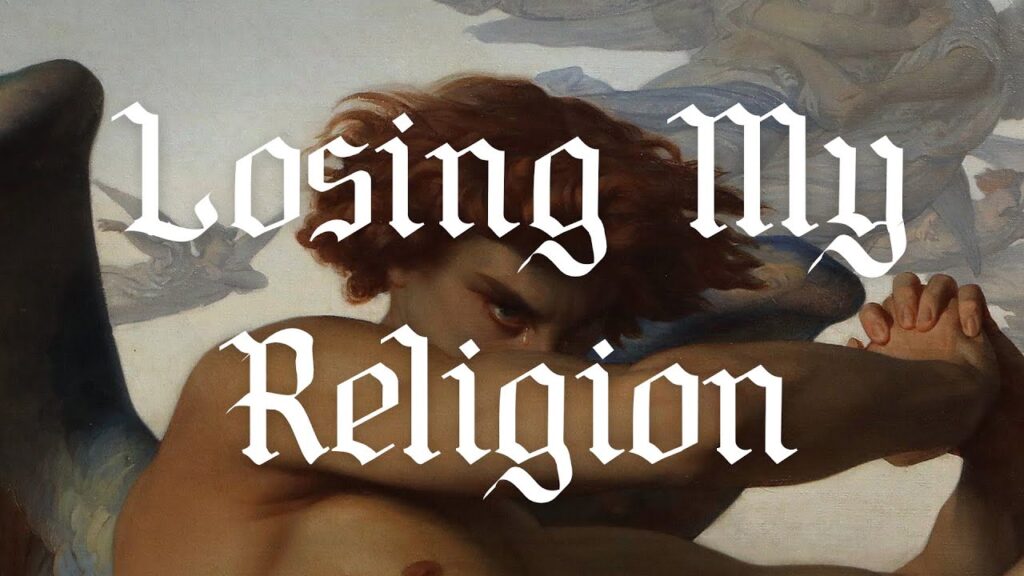
Losing My Religion

“That’s me in the corner, that’s me in the spotlight, losing my religion.” (R.E.M.)

I heard it again today.  Another high-profile Christian announced he is no longer a believer and has left the faith.  I could mention his name, but he is not the first and sadly will not be the last.

For those of us who still consider ourselves Christians, events like this always raise hard questions.  What leads people into, and in this case, out of, the Christian faith?  Can a person actually lose their salvation?  Can and will they ever return to the fold?  How should we react to the news and toward the person involved?

There are other questions that could also be asked, but I only want to focus on the second part of the first question: Why do some people leave the faith?  It’s a question I’ve been asking a lot recently, and the answers have been interesting.  One person told me he left Christianity because of disappointment with God.  But in coming back to the faith after thirteen years of active rebellion, he saw in retrospect, his disappointment was really just another form of idolatry.  He wanted God to meet Him on his own terms.  My friend didn’t want God to be God.  He wanted God to be who (or what) he wanted Him to be.

Another factor is something I call, “celebrity culture.”  In an age when every aspect of your life can be broadcast across the entire planet in an instant, and be massively responded to by complete strangers, the pressures to conform, perform, and not offend, can be truly overwhelming.  If I don’t want to offend others and try to defend unpopular beliefs, the easiest thing to do is leave them behind.  Pressures like these were certainly there in Paul’s time as well.  Galatians 1:10 makes it clear that the temptation to be a people-pleaser rather than a God-pleaser was and remains a powerful and dangerous force.

I thank the Lord often that He did not make me famous and overly gifted.  Celebrity culture and the possession of exceptional talents can be terrible things to manage when you’ve had few chances to mature and trust in God without the eyes of the world fixed upon you.  Add to that the profound temptations and pressures that come with money, fame, and influence, and you have a perfect combination for performing and playing a character different than yourself, not just on stage but in every aspect of your life.  It was a blessing that I did not become a professor until I was well into my forties.  It gave me time to grow and mature away from any limelight, even a dim one like serving at the East Asia School of Theology in Singapore.  And praise God, I have never had to endure the curse of being rich or famous.

Friends I have talked to who walked away from faith often explained that their journey out of Christianity was related to disillusionment with the Church or with certain Christians as well as embarrassment with certain Christian doctrines and demands.

It happened in Paul’s time as well.  Demas, “having loved this present world,” deserted Paul in his time of greatest need (2 Timothy 4:10).  Others like Hymenaeus and Alexander “made shipwreck of their faith” (1 Timothy 1:19-20) by denying the simple gospel message that “Christ Jesus came into the world to save sinners” (1 Timothy 1:15).

It’s easy to ask the question: Why did we lose so many of the next generation in America?  While many theories have been offered, ultimately, the answer is that we failed to adequately be and make disciples.  Among other cultural temptations, we were taken into and over by the social media tsunami just like everyone else.  We bought the lie that entertainment was a good substitute for sacrificial living in and for Jesus Christ through the power of the Holy Spirit.

We demanded little of ourselves and others, our youth included.  We “attended” church rather than understanding that we don’t come to church.  We, through our loving sacrificial service under the Lordship of Christ, are the church.

Youth have much more personal power and affluence than previous generations who were far more dependent upon their elders.  This power in the hands of the immature can be a terrible source of temptation to think that they are self-sufficient and have no need for God.  In addition, cultural attitudes towards Christians have radically changed.  In the past, it was socially acceptable to be a Christian and a decent moral human being.  Now, you are considered a pariah, a dangerously judgmental, bigoted, cis-gendered homophobe if you dare to take certain teachings and admonitions of Scripture concerning our sexuality with any significant degree of submissive seriousness.

As Bob Dylan reminded us way back in 1979, every person and every generation must choose whom or what they will serve.  If we claim that we will serve the Lord, we also must be ready to face and live out the hardships and challenges inherent to a life devoted to Him.  His path took Him through daily difficulty, ruthless ridicule, severe suffering, and cruel crucifixion.  But it also led to glorious triumph and resurrection life.  But His path to victory passed through sacrificial humiliation and excruciating death.  As His disciples and followers, we, too, are called to be conformed to His death (Philippians 3:10).

I am not a doomsday prophet.  As always, God is infinitely bigger than this recent mass exodus from the faith of our fathers, but this is still a tragedy on many levels, and God will not be patient or mocked indefinitely.  At some point He will act in righteous judgment against those who openly shake their fists at Him or consider Him irrelevant or dead.

As 2 Peter 3:9-10 hopefully but also ominously warns, “The Lord is not slow to fulfill his promise as some count slowness, but is patient toward you, not wishing that any should perish, but that all should reach repentance.  But the day of the Lord will come like a thief, and . . . the earth and the works that are done on it will be exposed.”  Make no mistake.  Sooner or later, God’s judgment is coming.  If you choose to walk away from Jesus, you will lose a lot more than just your religion.  You will lose your only chance for eternal life and everlasting hope in Him.

We Will All Be Forgotten

Compared to the number of people who have lived and died in recorded history, precious few names have been preserved.  Nearly all of the well-known names of our time will be rapidly forgotten when the next generation of the rich and (in)famous replace them.

It’s a cruel irony when a name so revered and extolled in one generation becomes a virtual nobody in the next.  After death, well-known people rapidly move from the catalogue of “who’s who” to the list of “who’s that?”

If you need any proof, let me give you a list of people who were once considered famous and important.  Nils Bohlin, Philo Farsworth, Maurice Hilleman, Witold Pilecki, Gavrilo Princep, James Harrison, and Henrietta Lacks.  These names were not concocted—look them up if you want.  They were all important figures in the last century, and the last time I checked, one is still alive today.

Truth be told, most of us live our lives in a desperate and futile attempt to be revered and remembered by those who come after us.  We want an enduring memorial, an unfading plaque, an indestructible stone statue.  Or we convince ourselves that we will somehow live forever through our progeny.

And here is my confession: I know virtually nothing about even my recent ancestors.  While my grandfather worked hard to catalogue his family tree, as I looked at the yellowing pages of the booklet he created, they were little more than names on a page.  And in a few short years, I, also, will only be a name on a page—but only if someone cares enough to become a family historian and record it in a genealogy.

If history tells us anything, it confronts us with reality that our lives are not only fleeting; they are also forgettable.   As such, it is extremely likely that no one will know or remember anything about me (or you) just two or three generations from now.  People move on with their lives and mostly share their own stories with their immediate family and friends.  The vast majority of who we are and were, and what we do and did, will vanish completely in the relentless mists of time.

The Bible speaks to this reality in a variety of ways.  Psalm 90:10 warns us that “The years of our life are seventy, or even by reason of strength eighty; yet their span is but toil and trouble; they are soon gone, and we fly away.”  Ecclesiastes 12:1-7 reminds us to “remember also your Creator in the days of your youth,” before it’s too late and we can no longer see well, work well, eat well, hear well, walk well, or sleep well.  And Psalm 103:15-16, tells us that a person’s “days are like grass; he flourishes like a flower of the field; for the wind passes over it, and it is gone, and its place knows it no more.”

Let that sink in for a moment: “It is gone, and its place knows it no more.”  Yes.  We will all be forgotten.

But before we get too dismayed or discouraged about the raw reality of our fleeting and forgettable lives, let me be crystal clear: Just as it says in Psalm 90:12, this is not intended to be depressive so much as it is meant to make us wisely realistic.  Of course, if we believed like the materialist that this life is all that matters and all that anyone lives for, we would have good reason to despair.  If there is no one and nothing beyond this life, we are fooling ourselves if our life’s goal is to make a name for ourselves, to leave behind memorials, houses, lands, big bank accounts, and a lengthy list of descendants.  As Ecclesiastes 12:8 pointedly says to all who give their lives to such vain pursuits: “Meaningless!  Meaningless!” says the Teacher.  “Everything is meaningless!”

But in magnificent and glorious contrast, the message of the gospel is equally clear.  Our lives, though fully forgotten by those who come after us in this life, still matter and have meaning to God.  He never forgets, and if we trust in Jesus, He will gather us to Himself when our momentary lives are over.  We will not only be remembered (Psalm 105:8), we will be embraced (Luke 15:20), celebrated (Luke 15:23), commended (Matthew 25:21, 23), and completely known in love for all eternity (1 Corinthians 13:12).

Again, let that really sink in for a moment.  If we know Jesus, the God of the universe knows us, loves us, and remembers us and will continue to do so forever and ever.  Herein lies our unwavering purpose, undeserved wonder, and unending hope.

Should Christians engage in “culture wars?”

I have never been a big fan of fighting what has come to be called the “culture wars” in America.  I find moral politics and legislative haggling to be tiresome and messy.  But even more, these cultural conflicts can become for the church a terrible distraction and barrier to keeping Jesus Christ and His gospel our central concern. Recently, however, with the rapid rise of power politics and the overt legal threats brought against the free exercise of religion, I have been rethinking the role of political and legislative power.

The tension here is that many Christians see the use of political and legal power as a misunderstanding, misuse, and distortion of divine power and priorities.  To some extent, that is certainly true.  But in another very real sense, when enforced policies and political power moves become matters of causing harm, then at what point is the Christian obligated to use means of power—political power included—to protect the innocent and promote the common good?

There’s no doubt that at some important level, Christians have a responsibility to protect human life.  Proverbs 24:11 says, “Rescue those who are being taken away to death; hold back those who are stumbling to the slaughter.”  And as Genesis 1:26 makes clear, as gendered divine image bearers, we are also responsible to lovingly steward and rule over God’s creation in ways that honor Him.

In my mind, many of the recent moves to demand greater access to and funding for abortion alongside the full affirmation of the LGBT+ agenda as well as the active promotion of medical interventions to “transition” youth who are struggling with gender dysphoria are good examples of areas where real and lasting harm is being done to the people directly involved in these decisions and lifestyles.

You can call it a “culture war,” or something else, but when real and active harm is being done to people, then beyond active avenues of persuasion, all legal and political means should be used to protect those who would otherwise be harmed, even if that might mean protecting some people from themselves.  This is where libertarian freedom fails to recognize that in a world suffering the consequences of the fall, unbridled liberty is an open invitation to the harm of self and others.

In short, we are all sinners, and sometimes we need to be protected not only from others, but also from ourselves.  And whether or not we admit it, there is a cultural and spiritual battle being waged.  This battle is not merely a set of abstract arguments for a vision of what constitutes the common good.  It is a concrete battle being waged in real time and real space.  Right now, specific people are being harmed and becoming casualties in the process.

Christians who claim to love God and His justice should not turn a blind, indifferent, or fearful eye away from these real-life tragedies currently unfolding before us.  We must wisely and appropriately use whatever power God has graciously given us to humbly, lovingly, and courageously fight for those who need to be protected from the devilish and destructive deceptions and deeds of our time.  As G. K. Chesterton reminds us, “The true soldier fights not because he hates what is in front of him, but because he loves what is behind him.”

Reflections at Sixty

I recently turned sixty.  A lot of water has passed beneath the bridge of my life with what feels like dizzying speed.  How could I have lived six decades already?  Where in the world has all the time gone?

As I reflect, I am struck first and foremost by a deep sense of gratitude.  God has blessed me with so many precious people who have deeply impacted me: parents, family, friends, wife, children, and grandchildren.  I have been given so much more than I deserved through the years: food, clothing, shelter, and health.  There have been incredible and undeserved opportunities to serve God and help others to come to know and grow in their walks with Him all over the world.

Of course, there are many regrets.  I openly acknowledge my many shortcomings, failures, character flaws, and sins.  I wish I were more patient, more humble, more kind, more emotionally engaged and mature.  I wish I were a better listener, asked more and better questions, had a greater sense of teachability and curiosity.

I somehow thought I would be significantly further along in my personal and spiritual maturity by now.  And while I have known many precious moments with Him, I believed that walking closely with Jesus would be easier and sweeter by now than it actually is.  My Christian life is still a daily struggle of wrestling with sin, character flaws, and bad habits.

Beyond this, there have been many deep heartaches and profound disappointments.  Some family and friends have disheartened me by walking away from the faith.  I’ve also caught myself asking: What has my life meant and accomplished?  I had big dreams in my youth.  Have I really followed Jesus whole-heartedly?  Has my life truly mattered and made a difference, making a lasting impact that genuinely honors God?

Nevertheless, in the face of all this, God’s goodness and faithfulness has been undeniable and unwavering.  I see without question the kindness, grace, and patience of a compassionate God who continues to love, forgive, and provide for me a life I never dreamed possible and the privilege to be used by Him in ways I never deserved or could have imagined.

This life has been, is, and always will be, a gift.  And now that I am fast-approaching the increasingly evident tail-end of it, Joe Rigney’s words hold a special significance: “Those at the beginning and the end tell those of us in the middle: This was you: weak, frail, dependent, and needy.  This is you: weak, frail, dependent, and needy.  This will be you: weak, frail, dependent, and needy.  You are a vapor, here today and gone tomorrow.  And your life is not your own.  It is a gift.”

Thank You, Lord, for creating, loving, and saving me.  Thank You for continuing to transform and conform me to the image of Your beloved Son.  Thank You for graciously giving me sixty years of life.  And thank You for the astonishing hope of eternal life in Christ that enables me to look to the future with unspeakable joy versus devastating dread or deluded denial.  You truly are a gracious, kind, and loving God!

Temptation and Desire: When is it sin?

The rise of LGBT+ movement in our world today has produced a growing debate within the church about the nature of sin and temptation in relation to internal desires.  The silver lining is that it has forced Christians to think more deeply and reflect more biblically on the nature of these questions.

In a very basic sort of way, I used to think that when ungodly desires arise, you simply avoid sin by resisting and not fulfilling them.  But as I have thought more about same-sex attraction, there is an important difference from other kinds of desires.  Not only is the fulfillment of same-sex desire wrong, the desire itself is something that ethicists call, “disordered.”  That is to say, the desire cuts directly against the grain of God’s original creation order and would never arise in a pre-fallen world.

Adam and Eve, for example, certainly desired one another sexually before the fall and were able to righteously fulfill those desires in the context of marriage, but pre-fall, they would never have experienced same-sex attraction.  That kind of desire can only arise after sin has entered the world.  Thus, the desire itself is misdirected and one of the many results of sin and evil coming into the world.  But here is where it’s easy to get confused.

Some Christians have assumed that same-sex attractions will (at least eventually) subside if we only continue to wrestle against them and repeatedly affirm and live out our new identity in Christ.  Thankfully, for some this does result in a profound and lasting transformation of these desires, especially over time.  For many others, however, disordered desires like these persist and continue to assert themselves in powerful and intrusive ways throughout their lives, even as they seek to forsake and resist them.

We therefore need to avoid the simplistic and judgmental attitude that suggests that mere repentance and resistance will inevitably and assuredly cause the desires to cease or be transformed into properly ordered (in this case, heterosexual) desires.  This can even suggest that one of the primary goals of Christian holiness is heterosexual attraction rather than godliness.  Again, merely practicing repentance and continual resistance and avoidance alongside affirmation of our new nature in Christ still may not fully resolve or eradicate all same-sex desires.

However, we should not be so quick to therefore dismiss these desires as neutral or nearly harmless, just so long as they remain unfulfilled in concrete practice.  Unlike desires that are appropriate to creation order so long as they are fulfilled within the parameters set up by God in His word, same-sex attraction is inherently opposed to God’s creation order.  In short, the desire itself is inherently rebellious and therefore dangerous and disordered.

This helps highlight the fact that avoiding sin and moving toward holiness involves much more than merely resisting certain behaviors.  It also involves resisting inappropriate attitudes and desires.  Jesus was very clear when he said in Matthew 5:28 that “everyone who looks at a woman with lustful intent has already committed adultery with her in his heart.”  The phrase “lustful intent” (ESV) captures the idea here well.  It is not the mere presence of a lustful thought, but the “lustful intent” and entertaining of that thought as well as a refusal to immediately take it captive and mortify it that results in sin.  Such sin is still very real even though it is only committed within the heart and mind of the one who lusts and is prior to any concrete action to fulfill it.

To take the idea further, in Ephesians 5:3, Paul not only talks about high standards of sexual purity: “there must not be even a hint of sexual immorality, or of any kind of impurity,” just before this in 4:31 he also lists “bitterness, rage and anger,” as problematic, and not merely their results: “brawling and slander, along with every form of malice.”  “Bitterness, rage, and anger” are not behaviors per se.  They are, at their root, emotional states of mind that can easily set us on a trajectory toward ungodly (re)actions.  And here Paul clearly demands that we should seek, by the power of His Spirit (5:18), to eliminate them from our lives.

Is same-sex attraction parallel to these kinds of sinful emotional states?  James 1:14-15 helps answer this questions when it says, “each person is tempted when they are dragged away by their own evil desire and enticed.  Then, after desire has conceived, it gives birth to sin; and sin, when it is full-grown, gives birth to death.”  The progression here is that although the desire is described as “evil,” it only becomes sin after it “has conceived and gives birth” to a willful sinful mindset and not merely wrong actions leading to “death.”

It is still possible, for example, to be angry and yet not sin (see Ephesians 4:26).  If I refuse to entertain same-sex attractions each time they arise, must I still repent simply because I experienced a disordered desire?  Again, the desire to have sexual relations with someone of the same sex results from life in a sinful world and subverts God’s creation order.  It must never be entertained, embraced, or fulfilled.

This stands in stark contrast to “normal” and “ordered” desires like heterosexual attraction.  While these desires can be (and often are) badly abused and misapplied in very sinful ways, when fulfilled in their biblically-revealed (and therefore proper) contexts, they constitute the fulfillment of good and God-desired ends.  A disordered desire, on the other hand, should always be resisted and understood as opposed to the goal of godliness.  Thus, it is decidedly not a neutral desire.

Still, only when we let an evil desire fester and fail to take it captive does it actually become sin.  As Martin Luther quipped, you cannot keep the birds from flying overhead, but you can prevent them from making a nest in your hair.  The desires themselves might be wrong but having them does not automatically or inherently make me guilty of sin.

This has important implications for discipleship and how we characterize and deal with wrong and sinful desires.  We know, for example, that toward the end of His earthly ministry Jesus desperately wanted to follow His own will by escaping the suffering and horrors of the cross (Luke 22:40-44).  In short, He desired to do something other than God’s will.  Just like the temptations at the beginning of His public earthly ministry delineated in Luke 4:1-13, it was another time of profound testing.  But we also know that in the midst of that very human but clearly wrong desire to escape the cross and death, Jesus remained sinless (Hebrews 4:15).

It would be easy to simply say that every time I experience an evil desire or thought, I must repent.  But that can lead to a profound sense of shame that may be unnecessary since the mere presence of a wrong and evil desire may not itself constitute sin.  Yes, I might have to repent if I entertain or let that desire begin to move me away from devotion to Christ, but what I do at the moment of experiencing the desire, no matter how wrong, is what matters the most concerning whether I need to repent or simply resist and as quickly as possible find something—better, Someone—else to focus my heart and mind upon.

To briefly summarize, same-sex desire is disordered, pushing against God’s intended creation order.  And while having such a desire is one result of living in a sinful world, having such a desire is not, in and of itself, automatically sinful.  When desires like these come, we are called to actively resist and forsake them, taking them captive to the obedience of Christ (2 Corinthians 10:5).  This will often require accountability and encouragement (and perhaps rebuke at times) from other Christians also seeking to be holy, but it is a journey toward wholeness and holiness well worth taking.  Praise God, we also know the One who has gone before and walks that hard road of temptation with us, our battle-tested yet still perfect and sinless Savior and loving Lord, Jesus Christ.