While not an entirely new phenomenon, in our time, there is a growing epidemic of children cutting off their parents. Recent estimates put the overall percentage as high as 25% percent, and that percentage is higher among Millennials and Gen-Zers.
The reasons for this trend vary according to who you ask. Some say it’s because younger generations don’t know how to resolve conflict in a healthy way, so they just eliminate all contact with everyone with whom they disagree. Others say it stems from an increasingly emotionally healthy perspective that is willing to recognize and remove toxicity within interpersonal relationships. What is increasingly clear is that cutting off relationships with parents is now often applauded, even by some psychologists and therapists, calling it “courageous,” “healthy,” and “life-giving.”
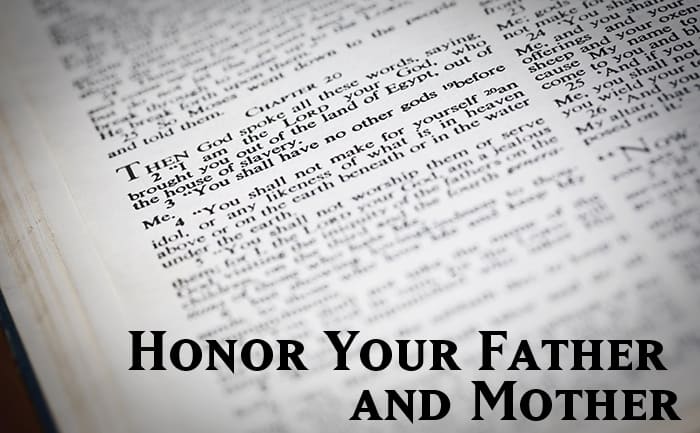
What does Scripture have to say about this trend? Perhaps the most directly relevant passage is the fifth commandment in the list of the Ten Commandments. Exodus 20:12 says, “Honor your father and your mother, that your days may be long in the land that the Lord your God is giving you.” A lot could be said, but I will make just four basic observations.
First, the commandment is highlighted by Paul in Ephesians 6:1-3 as unique because it is the first commandment coupled with a promise, namely “that it may go well with you and that you may enjoy long life on the earth.” In short, it’s profitable for the one who obeys it, and not merely for the parents who are honored. Both the child and the parents are blessed and benefit from fulfilling this command.
Second, like the other ten commandments, it is a God-given edict that is directly revealed by Him (Exodus 20:1). That gives it an undeniable weight and significance. Of all the possible things God could have put in His “top ten list,” this one came in at number five, just beneath the first four which all concern our relationship with God. It is the first in the list that directly addresses interpersonal human relationships with one another and is set within the confines of human family life. Again, this means it is something that really matters to God and is a crucial aspect to properly ordered human relationships within the family, the bedrock of human civilization.
Third, commandments aren’t given because the thing commanded is easy or comes naturally. If something was easy or natural, it would likely not need a commandment in the first place. Commandments are given precisely because the things they demand are both unnatural and hard. They typically require significant effort and personal sacrifice to fulfill. Children see their parents for who they really are in all of their weaknesses, sinfulness, and imperfections. And they often experience the brunt of those things as well. Let’s face it. It can be quite traumatic to be a sinner raised by sinners.
It would be easy to dwell on and point out every one of these failures and flaws. But in so doing, it would also be easy to fall into the trap of seeing oneself as the self-righteous and passive recipient of a deeply traumatic upbringing. In truth, most parents try very hard to be good parents and fail spectacularly at it. Few ever come close to being who and what they long for and aspire to, namely perfect parents. And they often keenly feel the burden, shame, and the guilt of their abject failures.
Children who choose to honor their parents are willing to exercise the godly traits of humble forgiveness, graciousness, and love, responding with kindness, courage, and compassion toward their imperfect parents. After all, “love covers a multitude of sins” (1 Peter 4:8), and we are called by Christ to forgive one another from the heart (Matthew 18:35).
Fourth, if the commandment is beneficial, important, and hard to fulfill, then we would do well to ask this basic question: “What does it look like to honor my parents?” What does the word, “honor” mean, and how long is the commandment in force? Does it cease to be important when a child turns eighteen and becomes an adult, or are there elements of the command that remain in force and still necessary to fulfill even after the child becomes an adult? What does genuine honor look like?
The word, “honor” essentially means to give weight and significance to, to consider important and valuable. This is helpful to understand since it is sometimes confused with the idea of obey and submit to, especially in Asia. While obedience is an important aspect of how children should respond to their parents, when they become adults, the notion of parental honor takes on a deeper meaning. In that context, honor does not mean obey so much as it means valuing and appreciating our parents as those who are to be esteemed, considered important, and seen as worthy of genuine respect and heart-felt gratitude.
In this sense, honoring parents means genuinely listening to, respecting, and taking their ideas and perspectives seriously as well as appreciating them as persons by virtue of who they are—your parents, the ones who in their weaknesses and sinfulness loved, raised, and sacrificed for, and agonized over you.
I don’t doubt for a moment that most children can produce a long list of genuine grievances and seemingly legitimate reasons for cutting their parents off. In some of the more extreme cases (like ongoing addiction and sexual abuse, for example), deciding for non-contact may well be an act of wisdom. But in Christianity, honor is something given not only to those who have earned it, but especially to those who need it and may not really deserve it. And according to this command, you don’t have to be a perfect parent to deserve honor. You don’t even need to be a remorseful, humble, and chastised parent. You only need to be a parent. That is the sole qualification.
Yes, honor can mean having painfully honest conversations about the ways in which your parents hurt and failed you. But it must also include a clear sense of appreciation, valuation, patient love, alongside an extravagant measure of grace and forgiveness, precisely because as Christians we have been lavishly loved, forgiven, and undeservedly showered with God’s unending grace.
Because God is the giver of this command, to honor our parents is to honor Him. If we want to honor Him, we must find ways to show our parents that they matter, are important to us, that we take seriously and give weight to what they think and have to say. You can’t do that when you cut them off from all interpersonal communication. Far from showing honor, that’s an act of rejection, dishonor, and disgrace, and God is not pleased.

