Tag Archives: Christmas

Where is Jesus?

As part of our yearly Christmas traditions, our family erected a Nativity display, complete with a wooden stable, plastic barn animals, shepherds, an angel, three wisemen, Mary and Joseph, and baby Jesus in a manger.  One year, however, baby Jesus disappeared.  Although we searched high and low, He seemed to have vanished into thin air.  When Christmas was over, we reluctantly packed up the stable, animals, and other important figures in the Christmas story, but baby Jesus, who was supposed to be the central figure of the scene, was still missing.

Sad to say, our family’s experience of losing Jesus has become a fitting metaphor for many of our lives at Christmas.  We pull out all the seasonal décor, attend holiday parties, anticipate family gatherings, and make lists for how many gifts and cards we will be giving and sending to others.  On top of all this, we are besieged with invasive displays and advertisements urging us to buy more and more things that promise to give us the joy and contentment for which we hope and long.

Of course, these promises are never fulfilled.  There always seems to be a bigger and better version of what we have purchased by the time the next Christmas season rolls around.  As a result, we frankly find ourselves exhausted and relieved when the whole holiday season is finally over.  And when it comes to Jesus, the real reason for the season, He often gets lost and forgotten in the midst of all the clutter, commotion, and clamor.

While we are busy hanging lights, we forget that Jesus is the light of the world (John 8:12).  Feeling the pressure to give everyone important to us a thoughtful and worthwhile gift, we forget that Jesus is the greatest gift of all (John 3:16).  We struggle not to overindulge and overeat, forgetting that Jesus is the bread of life (john 6:35) and the fountain of living water (John 7:37-38).  In all the hustle and bustle, we forget that Jesus promises rest (Matthew 11:28-30) and peace (John 14:27) for all who turn to and trust in Him.

Instead of finding Christ at Christmas, we find ourselves over-stimulated, overworked, overfed, and overwhelmed.  As Christians, if this is how we experience Christmas, perhaps we need to ask ourselves an important question: In the midst of all that is Christmas, where is Jesus?  Have I somehow missed or obscured Him in all the traditions and expectations, new and old, that now surround this increasingly hectic and frenzied season?  Have I sought to keep Him at the center of it all, or have I let other things conceal, crowd Him out, and push Him away?

Fortunately, the aforementioned story has a happy ending.  We never gave up hope that baby Jesus might appear someday, and several months later, He was found safely tucked away in my youngest daughter’s dresser drawer where she had laid and then forgotten about Him.  We restored Him to His rightful place of centrality in our creche, and all was right with the world again.

Similarly, every Christmas, we have an important choice to make concerning Jesus.  Because of all the distractions and expectations crowding Him out and drawing us away from the real reason for the season, we must decide: Will we let Him be lost in all the trappings and trimmings of this increasingly secular and market-driven holiday, or will we, like the wisemen and shepherds long ago, make Him the central focus of our interest by continuing to seek Him and joyously make Him known to all who will listen?
Jesus Amidst the Rubble

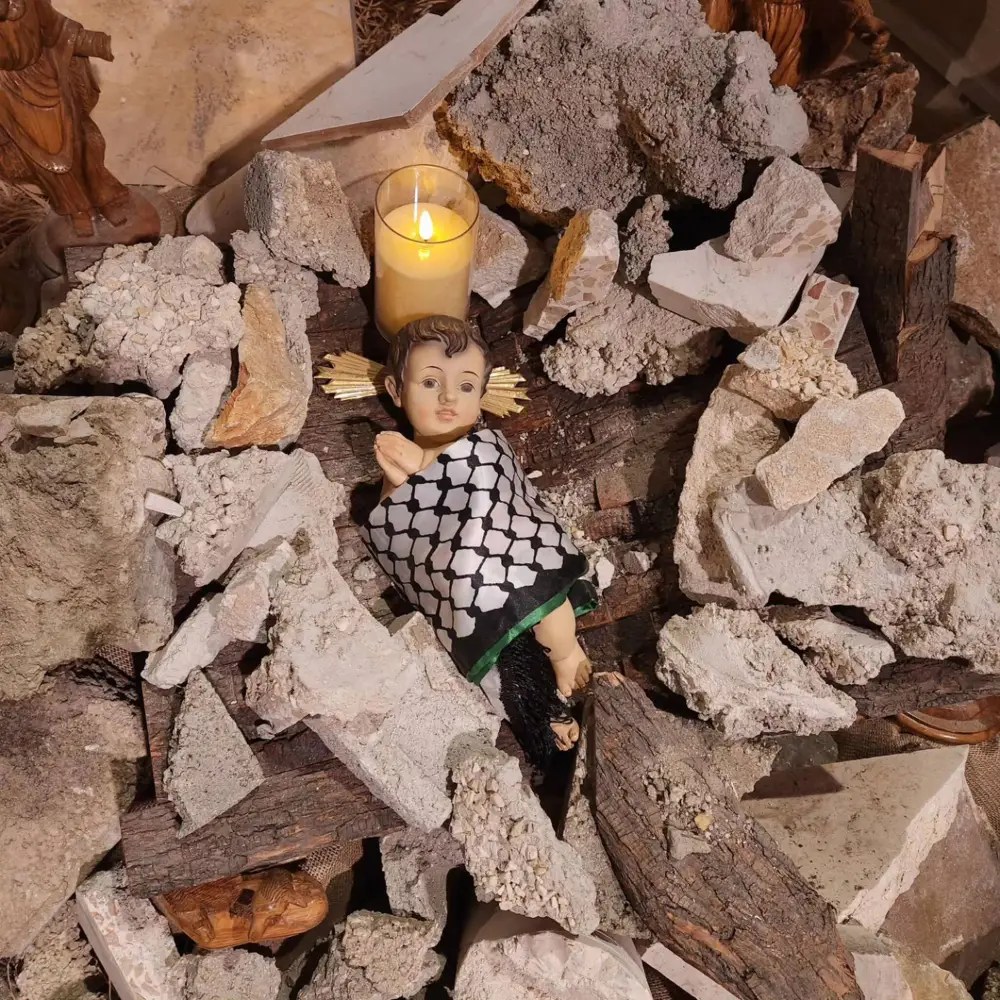
It’s all over the internet, a picture of baby Jesus lying amidst the rubble of a bombed-out building.  The idea is that if Jesus was born in Gaza today, He would not be safely lying in a manger on silent and holy night, but in a war zone with His life in desperate danger.

Doubtless, such an image helps shake us from the contemporary temptation to forget the radical nature of Christ’s coming to earth, not as a conquering messianic King like the Jews expected, but as the vulnerable suffering servant, born a defenseless baby in a tiny backwater town to a displaced peasant couple.

And when the angels appeared to announce His coming, they did not come to the rich, powerful, and well-connected.  They didn’t even come to His parents.  Instead, they appeared in the middle of nowhere to the lowliest of the low, a dirty, despised, and devalued class of people—shepherds—to make their declaration. And what was the message of this terrifying event?  A Savior is born “who is Christ and Lord.”  In short, He was the long-awaited Messiah (Christ in Greek), and He was Lord, the King above all Kings.

We know this in part because of Isaiah’s prophetic promise in chapter seven telling us that “the virgin shall conceive and bear a son, and shall call his name Immanuel,” and later in chapter nine that “the government shall be upon his shoulder, and his name shall be called Wonderful Counselor, Mighty God, Everlasting Father, Prince of Peace.  Of the increase of his government and of peace there will be no end.”

In this light, we would be deceived to think that Jesus’ birth was somehow safe, sensible, and apolitical.  Herod understood all too well the nature of Christ’s coming, and his paranoid political madness cost the lives of countless boys below the age of two because Jesus was a clear and present danger to his godless earthly reign.

Herod’s attempt to eliminate Jesus as a political threat, however, betrays the perennial tendency in our own time to make Jesus primarily an earthly political figure in a world of God-defying injustice, as if Jesus came to save the world by becoming another (presumably better) earthly king.  To be sure, He came as King, but a King who first and foremost came to serve, suffer, and sacrifice Himself to save us from the disordered debris of a world damaged and shattered by sin.

But it takes deep humility to recognize and admit our dire and dreadful state of disorder.  Instead, we desperately try to rebuild and renovate the wreckage of our lives, devising many creative and clever ways to deny or sweep it aside, reform it into more acceptable shapes and sizes, or even to somehow make peace with it.

The profound irony is that this seemingly helpless baby Jesus amidst the rubble is our only hope for restoration and peace.  He lovingly dwells in the midst of our battered and broken lives, miraculously molding us into something strong, significant, and beautiful.  But He only does this when we finally relinquish our futile attempts to redeem ourselves and fully trust in Him alone to forgive, restore, rebuild, and transform us from the inside out.

Finding Hope and Joy at Christmas

I have many fond memories of past childhood Christmases as well as those spent with our own children (now grown and on their own).  Children possess both a joyous anticipation and an enduring sense of wonder over the Christmas season.

Of course, not all this wonder and anticipation grows from the soil of pure motives.  Getting as many gifts as possible always lurks just below the surface.  And yet, many much more important things helped point our hearts in the right direction, bringing a genuine sense of joy and true anticipation: the spiritual rhythms of advent season at church, the Christmas eve candlelight service, the singing of carols, rituals of tree acquisition and decoration, special indoor and outdoor ornamentations, extended times of fun and fellowship with family and friends, cookie baking and eating, special meals, foods, and movies, the reading of the Christmas story, and so much more.  These holiday traditions afforded a deep sense of Christian grounding and identity in a world filled with bitterness and fear.

Too often in my adult years, however, the only sense of anticipatory joy is born of the hope that Christmas will soon be over so a “normal” pace of life can be restored.  Somehow in the rush to make Christmas memorable, I often forget to make it meaningful in all the right ways.  That sense of wonder and hope, so prevalent in childhood, is often nearly lost.

Not only this, the challenges of life in a fallen world keep forcing me to come face-to-face with the realities of living a world marred by sin.  More importantly, they continually reveal the many ugly and dark aspects of my own soul.  I find it harder and harder to escape the obvious sins, scars, and dysfunctions that seemed much easier to brush aside in youth.  But while the demands of the Christmas season can easily make us jaded and cynical in ways that push away any deep sense of joy, wonder, or hope, it is still possible to experience these things once again.

When Simeon took eight-day-old Jesus in his aged arms, he offered thanks to God this way: “My eyes have seen Your salvation that You have prepared in the presence of all peoples, a light for revelation to the Gentiles, and for glory to Your people Israel.”  Simeon’s faith-filled and joyous hope helped him see that God’s coming salvation for the whole world was somehow bound up in this holy Infant.  Reading the rest of the astonishing story, we see this truth ever more clearly, that Jesus is Immanuel, God with us.

Hope and joy may be in short supply these days, but when we take Jesus in our arms and gaze amazed upon Him once again, we can recapture that sense of joyous hope that our gracious God will wondrously save and restore all who hope and trust in Him.

God of the Unexpected

the_nativity

When people hear the word, “Christmas” it brings many things to mind, but I have to confess, one of the words that comes to my mind is expectations. I feel the expectations from every side.

Society expects us to buy lots of stuff, our neighbors expect us to decorate our homes, our friends and family expect us to send them gifts and cards. Our church expects us to attend extra concerts, plays, and productions, make shoeboxes for the needy, and reach out to our non-believing friends and relations.

Sometimes the highest expectations come from ourselves as we try to become superheroes and fulfill these expectations while still managing to make the perfect meal, complete with all the trimmings, deserts, and specialty items.

Now don’t get me wrong. Many of these expectations are wonderful things. But when they overwhelm and pull us away from the real reason for the season, we have allowed them to become one more idol that draws us away from our Lord, Jesus Christ.

When contemplating the first Christmas, you begin to realize that it actually did not fulfill a lot of expectations—in fact, quite the opposite. Through Christmas, God reveals Himself to be the God of the unexpected.

Mary expected to get pregnant only after getting married. She did not expect to be visited by an angel, impregnated by the Holy Spirit, or to have her baby—the God of the universe in human flesh—in a feeding trough. The angel Gabriel told her that her son, Jesus, was the One who would “reign over the house of Jacob forever, and of his kingdom there will be no end.” It consequently seems unlikely Mary would have expected to watch Him die an ignoble criminal’s death on a cross.

As an honorable man, Joseph expected to marry a virgin who hadn’t already been pregnant and birthed a child. He expected to be the biological father of his first-born son. He did not expect to have to take his pregnant virgin wife not only down to Bethlehem, but also to flee for their lives down Egypt and back. Nor did he expect to be father to the Son of God.

The shepherds expected to spend a quiet night like any other watching their sheep in the hills overlooking Bethlehem. They did not expect to have a terrifying divine visitation. Nor did they anticipate being granted the honor of seeing the Christ Child or being the first to proclaim His coming to a waiting world. They were the outcasts and rabble of society, and yet beyond all expectation, God chose them to hear and proclaim the gospel before any of the influential and wealthy in society had the chance.

Throughout His life, Jesus did not feel obligated to fulfill everyone else’s expectations. Instead, He was constantly failing to meet them. He castigated the rejected religious establishment while eating and hanging out with sinners and whores. He embarrassed and confounded His own family while creating a new community and a new way of loving one another. He perplexed and reproached His disciples but then entrusted them with the monumentally important task of taking the message of His love and forgiveness to the ends of the earth.

In the end, no one expected Jesus to die and rise from the grave to save the world from sin. But that’s exactly what He did, because Jesus had only one expectation to fulfill in this life. And according to His own account in John 17:4, He fulfilled it when He said to the Father, “I have brought You glory on earth by finishing the work You gave Me to do.” He did everything God asked Him to do—nothing more and nothing less. He obeyed, even to the point of dying on a cross.

Christmas is a time filled with expectations, but there is only one expectation that really matters, namely what the God of the unexpected expects of us. Micah 6:8 gives us a clue as to what that actually is: to do justice, to love mercy, and to walk humbly with Him, not merely at Christmas, but each and every day He gives us life.