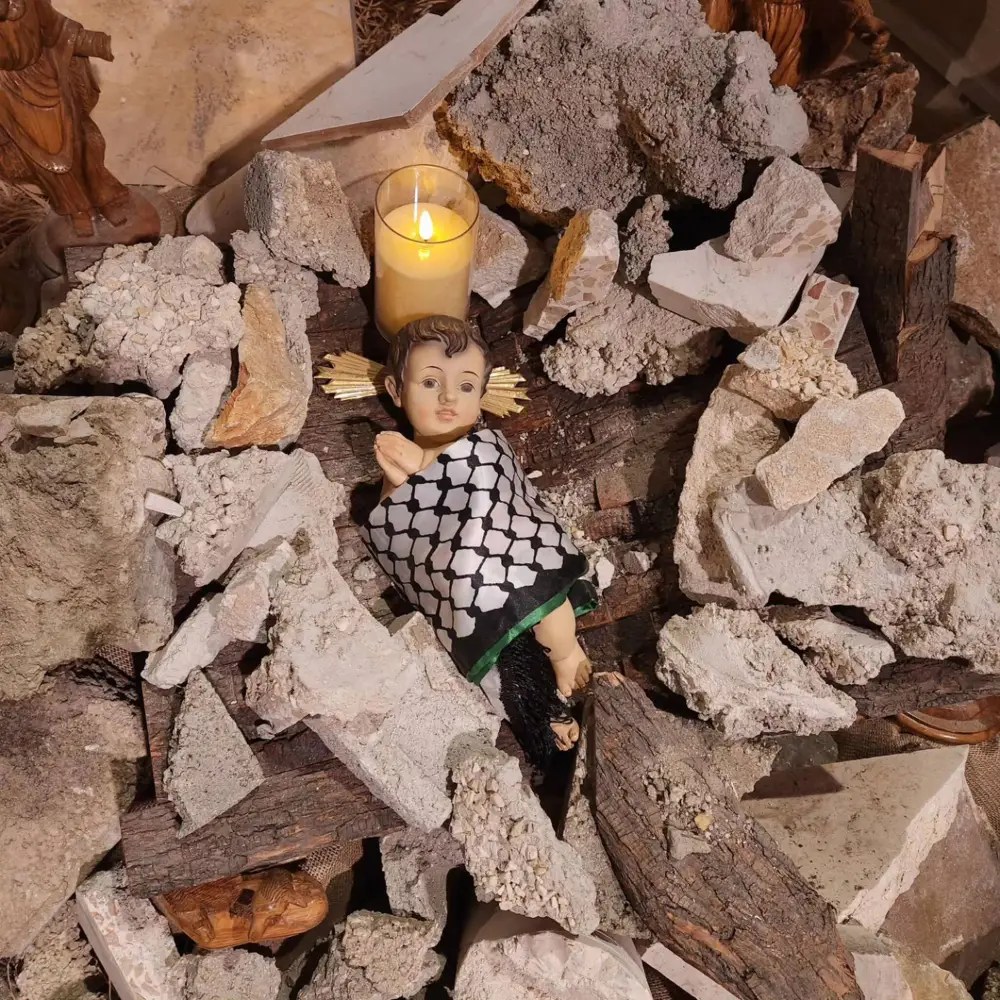
It’s all over the internet, a picture of baby Jesus lying amidst the rubble of a bombed-out building. The idea is that if Jesus was born in Gaza today, He would not be safely lying in a manger on silent and holy night, but in a war zone with His life in desperate danger.
Doubtless, such an image helps shake us from the contemporary temptation to forget the radical nature of Christ’s coming to earth, not as a conquering messianic King like the Jews expected, but as the vulnerable suffering servant, born a defenseless baby in a tiny backwater town to a displaced peasant couple.
And when the angels appeared to announce His coming, they did not come to the rich, powerful, and well-connected. They didn’t even come to His parents. Instead, they appeared in the middle of nowhere to the lowliest of the low, a dirty, despised, and devalued class of people—shepherds—to make their declaration. And what was the message of this terrifying event? A Savior is born “who is Christ and Lord.” In short, He was the long-awaited Messiah (Christ in Greek), and He was Lord, the King above all Kings.
We know this in part because of Isaiah’s prophetic promise in chapter seven telling us that “the virgin shall conceive and bear a son, and shall call his name Immanuel,” and later in chapter nine that “the government shall be upon his shoulder, and his name shall be called Wonderful Counselor, Mighty God, Everlasting Father, Prince of Peace. Of the increase of his government and of peace there will be no end.”
In this light, we would be deceived to think that Jesus’ birth was somehow safe, sensible, and apolitical. Herod understood all too well the nature of Christ’s coming, and his paranoid political madness cost the lives of countless boys below the age of two because Jesus was a clear and present danger to his godless earthly reign.
Herod’s attempt to eliminate Jesus as a political threat, however, betrays the perennial tendency in our own time to make Jesus primarily an earthly political figure in a world of God-defying injustice, as if Jesus came to save the world by becoming another (presumably better) earthly king. To be sure, He came as King, but a King who first and foremost came to serve, suffer, and sacrifice Himself to save us from the disordered debris of a world damaged and shattered by sin.
But it takes deep humility to recognize and admit our dire and dreadful state of disorder. Instead, we desperately try to rebuild and renovate the wreckage of our lives, devising many creative and clever ways to deny or sweep it aside, reform it into more acceptable shapes and sizes, or even to somehow make peace with it.
The profound irony is that this seemingly helpless baby Jesus amidst the rubble is our only hope for restoration and peace. He lovingly dwells in the midst of our battered and broken lives, miraculously molding us into something strong, significant, and beautiful. But He only does this when we finally relinquish our futile attempts to redeem ourselves and fully trust in Him alone to forgive, restore, rebuild, and transform us from the inside out.
 lewinkler